Retail & E-Commerce
How A Multi-Million Retailing Group Consolidated Chaos & Maximized Cash Flow
Four brands, thousands of styles, thirty-plus locations, no way to instantly see what sold or what was left. The platform that fixed it, and what it was worth.
A style starts moving. Not gradually — something close to what you launched last month turns up on the right person, and by the next morning the demand is real, and it is now.
You are the merchandiser. You need one thing: which counters still hold that style, and in which sizes. There are 28 of them, inside department stores spread across Java, and a single counter can carry 1,000+ SKUs.
So you phone the floor, and you wait. Sales from the counters reach head office a day late, sometimes two. The system you would otherwise check reports inventory as one figure — total closing stock, in rupiah, for the entire business.
By the time the picture assembles, the week is gone. Somewhere in it, a customer asked for her size at a counter that did not have it, and left. That size was sitting in the warehouse, or at a counter in another suburb where nothing was moving it.
None of that appears anywhere as a loss. There is no ledger line for the sale that did not happen, for advertising that pointed at an empty shelf, or for stock that will now be marked down at the end of the season. It surfaces later, in the margin, long past the point where anyone can trace it back to the afternoon that caused it.
- Client
- PT. Saga Machie
- Sector
- Retail & E-Commerce
- Engagement
- 2024 – Present
- Scope
- Advisory & Consulting
- Application Development
- Data Migration
- IT Support & Maintenance
- Systems Integration
- User Onboarding & Training
30+
Offline locations and online channels on one system
20,000+
SKUs across multi-variant products
2 weeks
Of monthly close, now posted automatically
100+
Staff working in the platform
About Saga Machie
PT. Saga Machie is an Indonesian fashion retail group running four footwear & accessories brands — Andre Valentino, ELLE, SNL and AVM — with 200+ employees. Its central warehouse holds 15,000+ units of inventory, and a fleet of trucks moves inventory between cities across Java.
Its retail footprint reflects how Indonesian fashion is actually sold. Of 30+ offline locations, more than 90% are consignment counters inside major department stores, less than 5% are self-managed stores, and several online marketplaces (channels) — Shopee, Lazada, Tokopedia, Zalora and Blibli. Consignment is the dominant model, and each department store carries its own reporting cadence, inventory rules and margin / payment terms.
That structure is what makes the operation hard. A single location can hold up to 1,000+ SKUs and several thousand units of inventory, and the same brand appears in dozens of counters run by different department store partners.
The challenge
What Saga Machie needed
The goal was not to buy or upgrade software. It was to remove the bottlenecks that grew more expensive the bigger the business got. That meant getting stores, consignment counters, the warehouse, merchandising and finance onto a centralized system that every team could trust — accurate enough to allocate stock against, and current enough to act on.
A single stock position. Inventory lived across a legacy ERP, marketplace dashboards and spreadsheets. No one view reconciled them, so the number a merchandiser planned against vs. the actual goods carried on shelves were rarely the same.
Visibility by location and by brand. Allocation decisions across 30+ locations and four brands need stock broken down by where it sits and what it is. Without that, buying and transfer decisions rest on human memory.
What stood in the way
For several years, the business ran on a legacy ERP system, and the constraints had become structural rather than incidental.
Reporting collapsed to a single number. The legacy ERP system surfaced inventory as a global rupiah total — a closing-stock line on the balance sheet — with no breakdown by location, brand or channel. For a business whose entire model is consignment across dozens of department store counters, the one dimension it could not report on was the one that mattered.
Stock transfers were a paper process. Moving stock from the warehouse to a counter ran to roughly twenty steps, touching warehouse staff, barcode printing, paper stocklists, data entry, printed delivery invoices, drivers and finally the sales staff receiving goods at the counter. Each handoff was a place for a document to go missing and for the system record to drift from physical reality.
People were doing system work. Staff re-keyed the same transfer data from a printed invoice into one system, then into another for accounting. Finance carried the same pattern: a five-person team, two of them reconciling sales and two entering accounting transactions, working from what other teams had already typed once. That is headcount spent on reconciliation rather than on selling or buying.
Seasonality raised the cost of getting it wrong. Indonesian retail peak sales concentrate heavily around seasonal holidays such as Ramadan or Nataru (Natal & Tahun Baru), when seasonal demand can spike by more than double vs. off-seasonal periods. Stock misallocation at 30+ locations is expensive in a flat month and far more so in a peak one.
The solution
Delos delivered Delos Retail — a retail operations platform configured to how Saga Machie actually works, rather than a generic ERP the team would have to bend itself around. Rollout was progressive rather than big-bang: inventory, transfers and sales first, then procurement and counting, with more than a hundred users onboarded in stages.
One system across every location and channel. All four brands, all 28 consignment counters, the boutique and all five marketplace channels run through a single platform. Warehouse stock, transfers, sales and inventory sit in one place instead of being cross-referenced between a legacy system, five marketplace dashboards and a spreadsheet.
Stock transfers, digital end to end. The full chain — goods receipt at the warehouse, merchandiser transfer planning, delivery, and confirmation by staff at the receiving counter — now runs in the system, with each movement tracked through draft, in-transit and confirmed states. Lost delivery invoices and duplicate data entry stop being part of the process.
Real-time inventory by location, brand and SKU. Management can see exactly what stock sits where, broken down along the dimensions the legacy system could not report on, rather than waiting on a manual report that is already days behind.
Consignment handled as a first-class case. Revenue share is calculated per partner and per item, and each counter’s stock position and reporting requirements are held in the system rather than maintained alongside it.
Procurement, goods receipt and stock opname. Purchase orders, barcode-scanned goods receipt, and inventory counting with import templates built for Saga Machie’s own counting workflow came online once the core was stable.
Mobile-first where the work happens. Receiving, transfers, picking, delivery and stock checks run from a phone, because counters and warehouse floors are not desks. Adoption is deliberately uneven: counters furthest from Jakarta, where staff turnover is highest, still submit sales on paper, and come onto the platform as the case for equipping them strengthens. Staging it that way was the client’s call, and it is why the rollout held.
Accounting connected to operations. Delos Retail posts straight into Accurate Online. Every operational document carries a mapping to the chart of accounts — sales orders, invoices and customer payments on one side; purchase orders, goods receipts, supplier invoices and payments on the other; stock adjustments and inter-location transfers alongside them — so a transaction recorded at a counter becomes a journal entry without anyone retyping it. Each entry carries the originating document number, which is what makes a line in the general ledger traceable back to the transaction that produced it.
The results
Delos Retail went live at end Q4 2024. The accounting integration followed in 2026, and this is the point at which accuracy on the shop floor started paying finance back.
The legacy system is gone. By early Q2 2026, Saga Machie was off the legacy ERP entirely — no parallel system running alongside, no team still working from the old reports.
Month-end close stopped being a re-keying exercise. Entering a single month of routine sales into the accounting system used to take two people the better part of two weeks, transcribing what the retail system already held. Those transactions now post themselves, and the finance team spends the month checking figures rather than producing them.
Corrective journal entries fell from around ten a month to one or two. A sale rung up in one month and typed into the books in the next used to throw both months out, and every one of them cost the tax and accounting manager a reconciling entry written after the fact. Posting from the operational record instead of from a person’s keyboard removed most of that class of error outright.
Every ledger line traces back to a document. Journal entries carry the originating sales order and invoice numbers, so a figure in the general ledger can be followed back to the transaction behind it. Answering “where did this number come from” is a lookup rather than an investigation. Carrying the location code through the same field, so the trail reaches the individual counter, is the next piece of that work.
Cost of goods and stock value follow the movements. Inventory valuation is derived from the goods receipts, transfers and adjustments the warehouse and counters already record, rather than entered into the books a second time and reconciled afterwards.
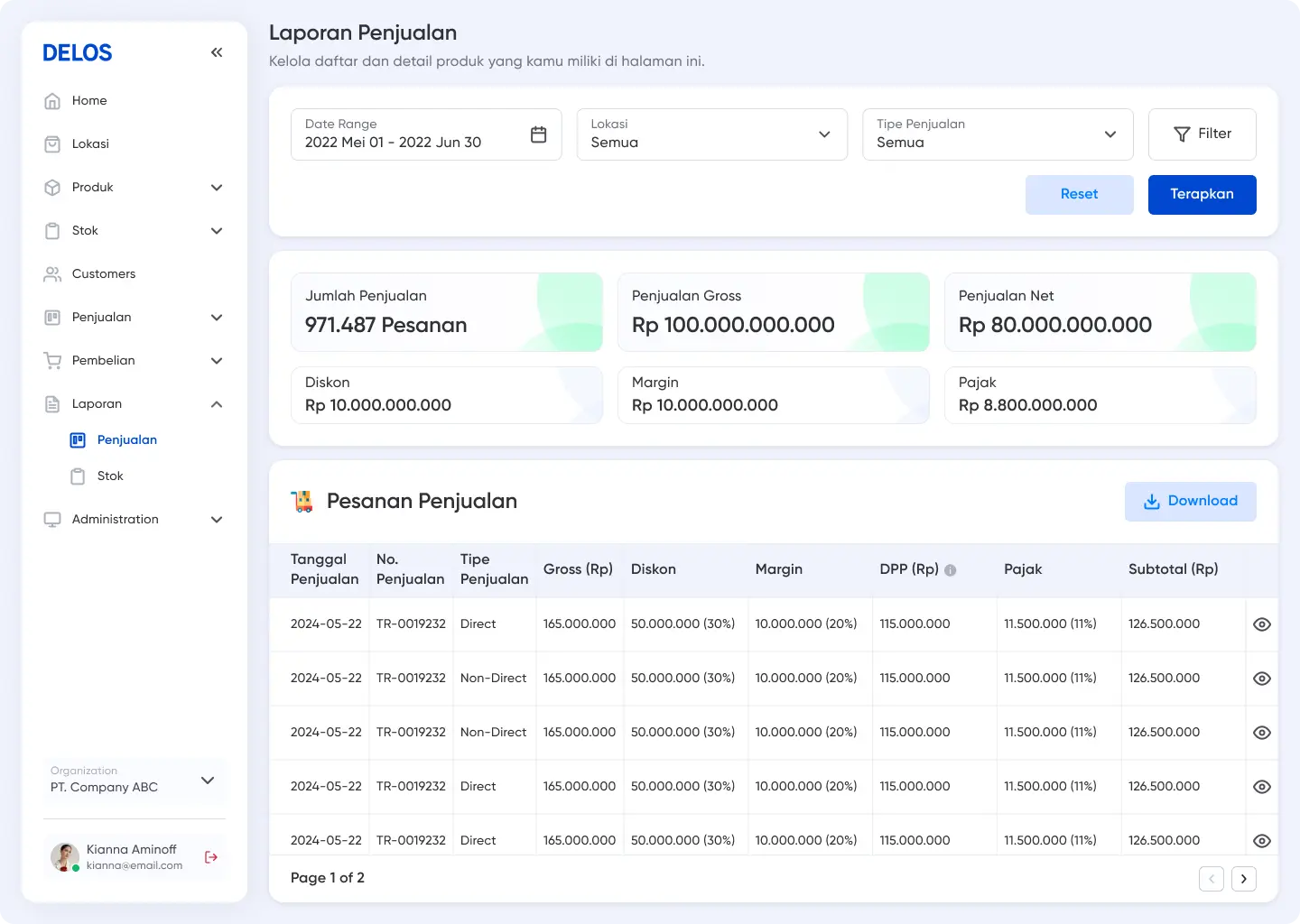
Reporting splits by location and channel. The dimension the legacy system could never produce — performance per counter, per brand, per marketplace — is how the platform reports by default, in place of the single closing-stock figure the old system could manage.
Finance is no longer tied to the office. The old system ran on a server in the building, so month-end happened at a particular desk. Both halves of the stack are cloud software now, and the people who close the books can reach them from anywhere.